
Small businesses can save 20+ hours monthly using AI Agents. Learn the 6 best deployment tips to automate finance, sales, and marketing tasks to drive growth.

For any small business owner, time is the single most valuable resource. Every minute spent on repetitive tasks is a minute taken away from strategy, customer connection, or innovation. The good news? The solution has arrived in the form of autonomous software known as AI Agents. Research shows that small businesses that strategically adopt these automation tools are often saving upwards of 20 hours per month in labor and realizing average operational savings between $500 and $2,000 monthly. This is not simply about using a chatbot; it's about deploying a reliable virtual workforce that handles full workflows. This detailed guide explores exactly how small businesses can use AI Agents to move beyond basic automation, multiply their efforts, and secure their path to stable growth.
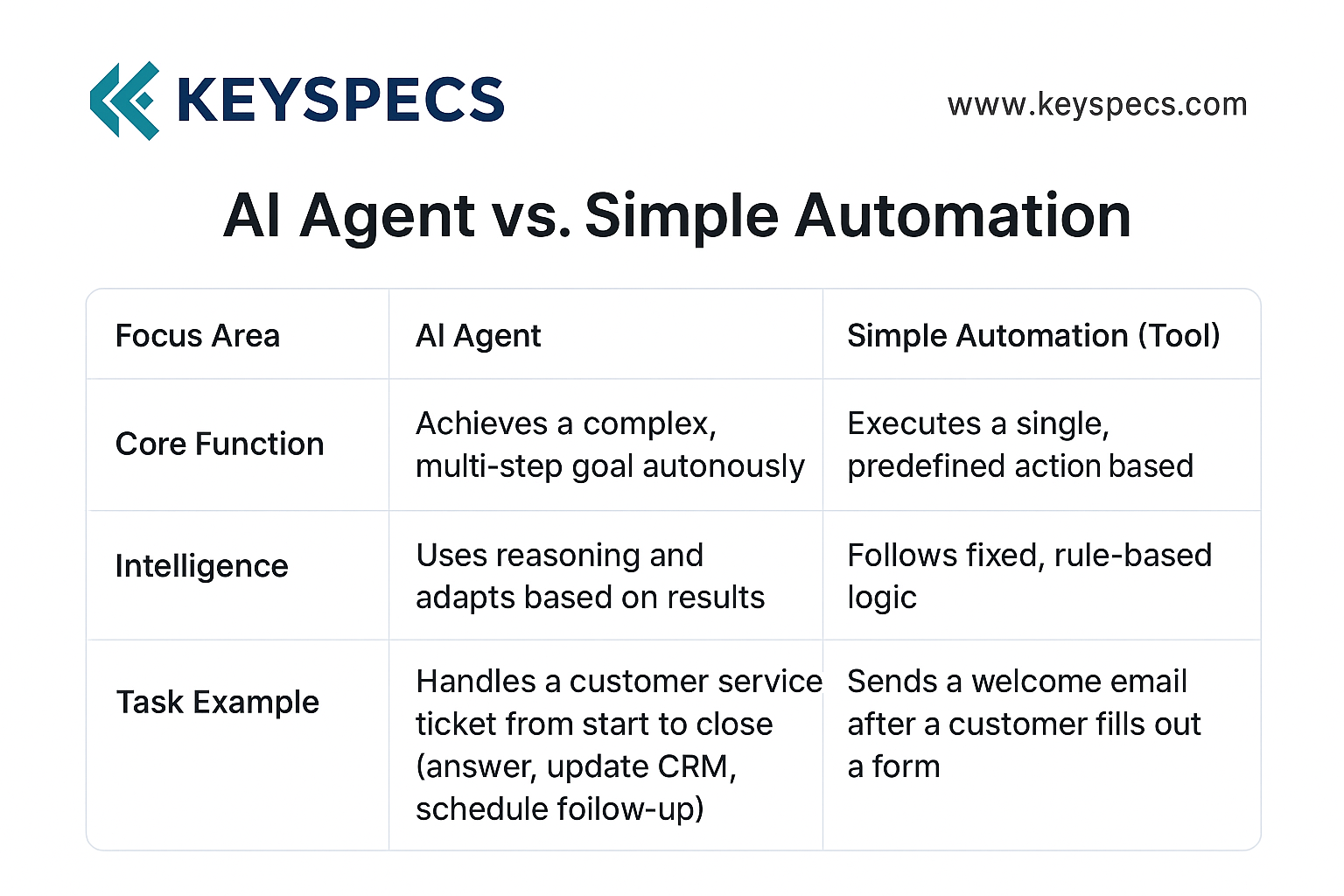
To understand the power of an AI Agent, you first need to know how it differs from the general AI tools you might already be testing. Most people are familiar with Simple Automation—the process of setting up a trigger and an action, like "If email arrives, then send a notification." It makes one step slightly faster.
An AI Agent, on the other hand, is software that can perceive its environment, reason through a goal, and execute a series of multi-step actions autonomously to achieve a business objective. It doesn't need a prompt for every single step. It is goal-oriented, not prompt-driven. This allows it to handle entire workflows.
For instance, Simple Automation might draft a social media post for you. An AI Agent will draft the post, research the best hashtags, schedule the post across three platforms, and then log the performance data into your sales dashboard. It completes the whole job, start to finish.
Here is a clear look at how the two types of digital tools differ in what they can do for your business
Adopting AI Agents is a strategic move that fundamentally changes how a small business can compete. The benefits go far beyond just time saved
To realize those 20+ hours of monthly savings, you must approach agent deployment with a smart, focused plan.
Here are our top six tips for small businesses
Do not try to automate your entire sales process on day one. Begin by pointing your agent at a task that is done constantly but where an error is not catastrophic, such as classifying incoming support emails or summarizing sales meeting transcripts. Success here builds confidence and proves the value quickly.
An agent is only as powerful as the tools it can access. Choose agents that integrate seamlessly with your existing CRM (like HubSpot), accounting software (like QuickBooks), and calendar. The less you have to manually move data, the more time you save.
An agent cannot work effectively if it does not know your rules. If you use an agent for content, it must be trained on your brand style guide. If you use it for finance, it must be trained on your specific categorization rules. This is essential for maintaining quality and consistency.
You do not need to hire a developer to build an agent. Platforms like Zapier and Make now have robust agent capabilities that allow a business owner to describe a workflow in plain language and have the agent build it.
Even though agents are autonomous, one person should be responsible for monitoring their performance, checking for errors, and giving them new instructions. This prevents system overlap and guarantees accountability for the automated workflows.
AI Agents are there to multiply the efficiency of your human team, not replace them. When an agent takes over 20 hours of administrative work, the human team should focus those 20 hours on personalized customer outreach or strategic planning, making the business stronger.
The marketplace for AI Agents is growing quickly. Small businesses should focus on platforms that offer ease of use and strong integration with standard business apps. Here are three main types
While human talent is essential for strategy and creativity, agents offer practical advantages for high-volume, automated tasks:
First, Predictable Cost and Zero Overhead. A new employee requires salary, benefits, training, and management time. An AI Agent has a clear, predictable subscription cost. This allows small businesses to budget and scale services without the financial risk associated with hiring.
Second, Instant, Flawless Performance. Agents do not get tired, distracted, or sick. They perform repetitive tasks with 100% accuracy and availability, 24 hours a day. This consistency is impossible to achieve with human labor and is vital for tasks like compliance checks and data logging.
Third, Immediate, Scalable Deployment. When your business grows fast, a new agent can be deployed to handle the increased load (e.g., a surge in sales orders) instantly. Scaling human teams takes weeks for hiring and onboarding; scaling an agent takes minutes with a few clicks.
AI Agents are more than just a passing tool; they represent a fundamental shift in how small businesses structure their operations. The future is moving toward the "agentic organization," where human teams work alongside their virtual counterparts.
For example, a marketing director will not spend time drafting social media posts. Instead, they will manage a Marketing Agent that is responsible for all content creation and scheduling. The director's job becomes higher-level: setting the strategy, ensuring the agent's tone is correct, and analyzing the performance reports the agent generates.
This structure allows small companies to move resources away from basic execution and toward complex, creative thinking. The AI handles the logistics; the human handles the vision. This partnership is what makes a small business competitive against much larger enterprises.
While this article is about AI Agents, the original concept asked about assessment platforms. The best way to adapt that idea is to talk about the tools needed to assess your business's readiness for AI and automation.
To prepare your team and systems for AI Agents, you need these tools:
While the focus here is on readily available, off-the-shelf agents, the larger challenge for many small businesses is the strategy behind which agents to deploy and how to integrate them securely. This is where strategic partners become critical.
Keyspecs, a leader in Digital Transformation Solutions, steps in to provide the Technical Consultation necessary to build the framework around your agents. We help established organizations and Startup Ventures plan the architecture, security, and long-term vision. The difference is that a generic provider helps you set up one agent; Keyspecs helps you design a resilient, profitable, agent-powered operation.
The time drain is real. The pile of emails, the endless data entry, the missed follow-ups these are the small, daily frictions that keep a small business from becoming a large one. For too long, the solution to this was simple: hire more staff or work longer hours. Now, there is a third, more effective way.
AI Agents are not futuristic science fiction; they are operational reality. They are providing entrepreneurs with the single most valuable resource they lack: time. By strategically deploying these autonomous systems in sales, finance, and marketing, you can stop focusing on the clock and start focusing on growth. The opportunity to save 20+ hours per month is available right now. The businesses that embrace the autonomous workforce will be the ones that win the next decade.
A chatbot is reactive; it can only answer questions or follow simple scripts. An AI Agent is proactive; it perceives a situation, reasons about the goal, and takes multi-step actions on its own, like updating a database or scheduling a meeting without being asked for each step.
Many entry-level agents, particularly those integrated into existing tools like Zapier or HubSpot, start with free tiers or low monthly costs (e.g., $20 to $50 per month). The median cost savings for businesses using them is often between $500 and $2,000 per month, making the return on investment (ROI) immediate.
The safest tasks are high-volume administrative duties that are low-complexity, such as categorizing incoming customer service emails, logging data from a spreadsheet into a CRM, or generating initial drafts of routine content like social media updates.
Yes. Specialized Conversational Agents can handle roughly 70% of common customer inquiries 24/7, providing instant and accurate answers based on your business's official data. They escalate complex or urgent issues directly to a human team member.
No. Most modern AI Agent platforms for small businesses (like Zapier, Make, and built-in CRM agents) are no-code or low-code. They use visual interfaces or allow the user to describe the desired workflow in plain language, making them fully accessible to any small business owner.

Author
Growth Marketing Strategist
